 Vidova
Bar chart race
A ranked bar chart race over dark footage. Your question opens it, the bars shoot out on the beat from the smallest to the leader, and the source shows at the end.
What Vidova will do
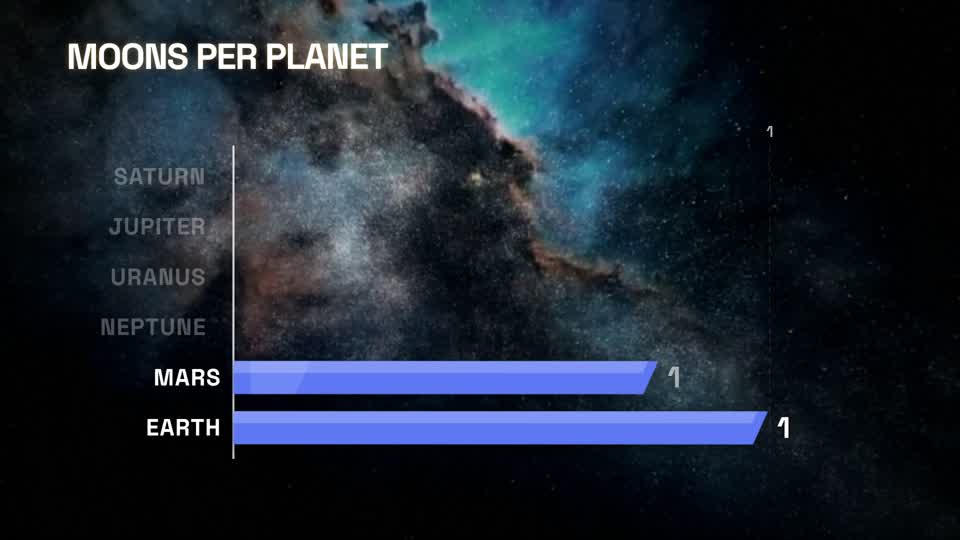
Make a 16:9 bar chart video of which planet has the most moons, over space footage. Grow the bars from smallest to largest, count up the numbers, and call out Saturn at the end. The video is 19 seconds long, 1920 by 1080, cut to a building sci-fi game track at 123 beats per minute. Footage: I attach three space shots. The first is a flight through a nebula. The second is a very dark, slow nebula that I can slow down to 0.4 times speed for behind the chart. The third is the Earth turning. Look: A dark science channel look. Add light film grain over everything. The hook is cool and saturated with strong contrast. The chart section is very dark, cool and desaturated with a heavy vignette, so the bars read clearly. The outro is a little lighter than the chart. The amber accent is #ffb23e and the bars are blue (#5b7cfa). Hook: From 0 to 3.76 seconds the nebula flight fades in from black over 0.4 seconds and pushes in slowly. Low on the left, a small tracked amber kicker says "CONFIRMED MOONS · 2025". Under it, the question rises in letter by letter in big white Space Grotesk Bold capitals: "WHICH PLANET HAS" on the first line and "THE MOST MOONS?" on the second, with "MOONS" in amber. Do not show the answer yet. Chart: At 3.76 seconds the dark nebula cuts in with a white flash and a whoosh. Across the top left, the title "MOONS PER PLANET" types on letter by letter in white capitals. The chart sits in the middle of the frame. The planet names are in white capitals on the left. The bars grow from the smallest to the largest, one every two beats, at about 4.69, 5.6, 6.5, 7.45, 8.41 and 9.38 seconds, with a soft tick on each: Earth 1, Mars 2, Neptune 16, Uranus 28, Jupiter 95 and Saturn 274. Each value counts up at the end of its bar. As bigger values arrive, the axis stretches and the earlier bars shrink, like a bar chart race. The chart ends with Saturn on top. Leader: A riser builds into Saturn's bar while the music dips. When the bar lands at about 9.8 seconds, the music comes back and a deep impact hits. The footage punches in and shakes for a fifth of a second, with a white flash. Saturn's bar is the only amber bar, and it keeps a soft pulse. Half a second later a hand-drawn amber circle draws around the value 274, with the handwritten label "+128 in 2025" below it. Then a bell sounds and a callout rises in word by word near the bottom, in white Space Grotesk, with the number in amber: "128 of Saturn's moons were announced in 2025". Outro: At 15.05 seconds the Earth shot cuts in with a flash, a whoosh and a small turn that settles. On the right side, big white capitals say "EARTH HAS ONE", with "ONE" in amber, and a smaller line under it says "Mercury and Venus have none". An impact plays under it. In small print at the bottom right, in 75 percent white, it says "Source: NASA and the IAU Minor Planet Center, counts as of March 2025". Everything fades out at the end, together with the music.