 Vidova
How to make UGC ads with AI: real creators, AI presenters and the rules
What UGC means in marketing, how to make a UGC ad with AI from real creator footage, when a cloned voice or lip sync fits, and the FTC, TikTok and Meta rules to follow.
 Vidova team
Last updated
The short answer
UGC (user-generated content) is content made by customers or creators instead of by the brand. A UGC ad is a paid ad in that style: a real person on a phone camera shows the product and says why it works for them. With AI, you edit the creator's footage into a hook, proof and an offer, with captions. A cloned voice or lip sync needs the person's consent, true claims and an AI label.
Key takeaways
- A UGC ad is a paid ad that looks like a real person's phone video: a hook, the problem, the proof, the offer.
- Real people sell best. Use AI to edit their footage, caption it and make versions, not to invent a customer.
- Disclose payment in the video, clone a voice only with written consent, and label realistic AI content.
What UGC means in marketing
UGC stands for user-generated content: photos, videos and reviews that customers and creators make about a product, instead of the brand. When a customer posts a video of your product without being asked, that is organic UGC.
A UGC ad is a paid ad made in that style. A creator, often paid by the brand, films the product on a phone, in a real room, in their own words. The brand then runs it as an ad on TikTok, Instagram or YouTube. It looks like a recommendation from a real person.
That is also why the rules are strict. When a creator is paid or gets free products, the US Federal Trade Commission says the connection "should be disclosed clearly and conspicuously" (FTC).
What makes a UGC ad work
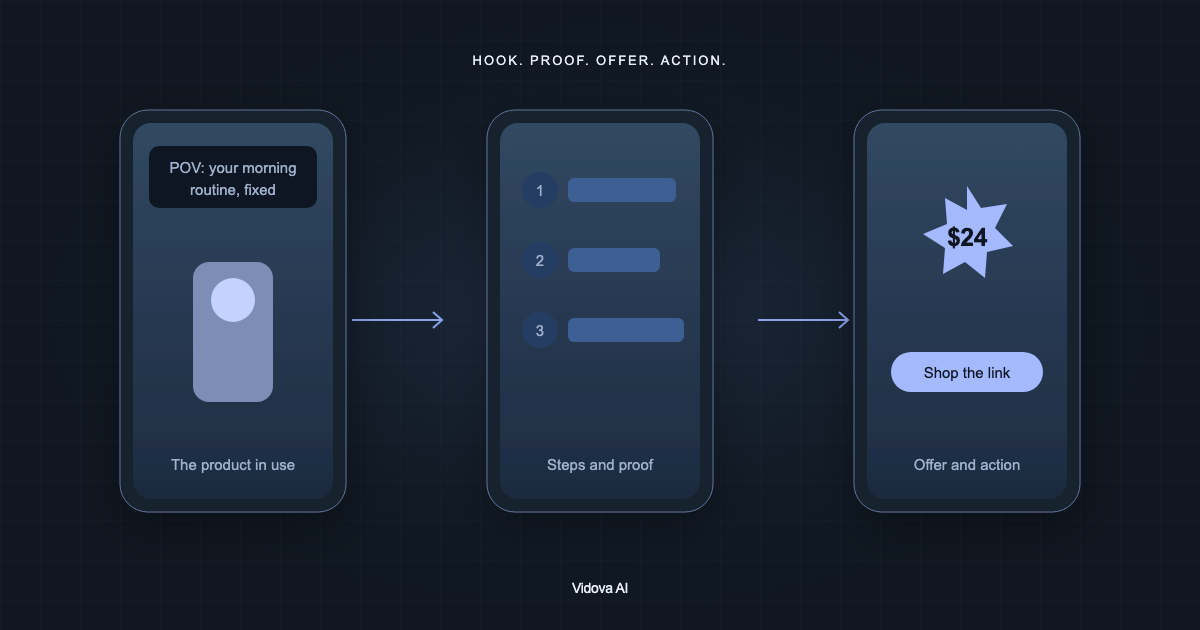
- Hook, first second: the product in use, close up, with one line on screen.
- Problem: the person says the problem in their own words.
- Proof: the product working: steps, a before and after, the result.
- Offer: the price or the deal, said once and shown large.
- Action: what to do now: shop the link, book, visit.
Keep the phone look: daylight, a hand-held camera, real rooms. Captions carry the words for people who watch with the sound off. Aim for 15 to 30 seconds.
Real creator footage or an AI presenter?
| Option | What it is | Fits | Watch out |
|---|---|---|---|
| A real customer or creator | Their own phone footage | Testimonials, reviews, "how I use it" | Disclose payment or free products in the video |
| Your own team | The founder or staff talking to camera | Demos, launches, offers | Say who they are |
| A real stock presenter, lip-synced | A licensed stock clip of a real person on green, made to say your line | Explaining features and steps | Never present it as a customer's own experience, and check the clip's licence for this use |
| A generated AI person | A person made by AI | Rarely a good fit | Looks fake next to real footage, and cannot give a real testimonial |
The last row matters most. The FTC's rule on reviews and testimonials, announced in August 2024, bans testimonials that "misrepresent that they are by someone who does not exist, such as AI-generated fake reviews", or by someone who "did not have actual experience" with the product (FTC). An AI person who says "this cream changed my skin" is that kind of testimonial.
In our own reels, a generated presenter looked fake, and a real presenter from the stock library, lip-synced to the line, worked. Vidova's stock library has green-screen clips of real people talking to camera.
Voice cloning and lip sync, with consent
Vidova clones a person's voice from a clean stretch of their speech, a few seconds with no music and no other voices, and lip-syncs their own footage to a new line. Only the mouth changes. The line can also be in another language.
- Fix a line the creator fluffed, without a reshoot.
- Make the same ad in Spanish, French or German with the creator's own voice.
- Shorten a long take into a 15-second version.
Get the creator's written consent for each use: the new lines, the languages, the platforms and how long you run it. The new line must still be true for that person. The FTC says an endorsement "must reflect the honest opinion of the endorser", and that a person cannot talk about their experience with a product they have not tried (FTC).
Disclosure and AI labels
- Paid or gifted: disclose it in the video itself. The FTC says a disclosure has the best chance of being clear and conspicuous when it is in the video itself, and when the endorsement is both seen and heard, the disclosure should be "made both visually and audibly" (FTC).
- TikTok: creators must label AI-generated or significantly edited content that shows realistic-looking scenes or people (TikTok). TikTok also labels AI content uploaded from some other platforms automatically, by reading Content Credentials (TikTok newsroom).
- Meta: Facebook and Instagram add "AI info" labels when Meta detects industry-standard AI indicators or when people disclose that they upload AI-generated content (Meta).
- YouTube: creators must disclose realistic AI-generated or altered content, including content where a real person appears to say or do something they did not (YouTube). A lip-synced new line is that kind of change.
These are US and platform rules, checked October 2026. Rules differ by country.
What to film or gather
- A close-up of the product in use for the hook.
- The problem: the cluttered shelf, the dirty car, the tired face.
- One shot for each step or detail.
- The result and a real reaction.
- A calm shot with space for the offer.
- The creator's line to camera, recorded two or three times, in daylight, with the phone upright.
- Your facts: the price, the offer and only the claims you can back up.
Make it in Vidova
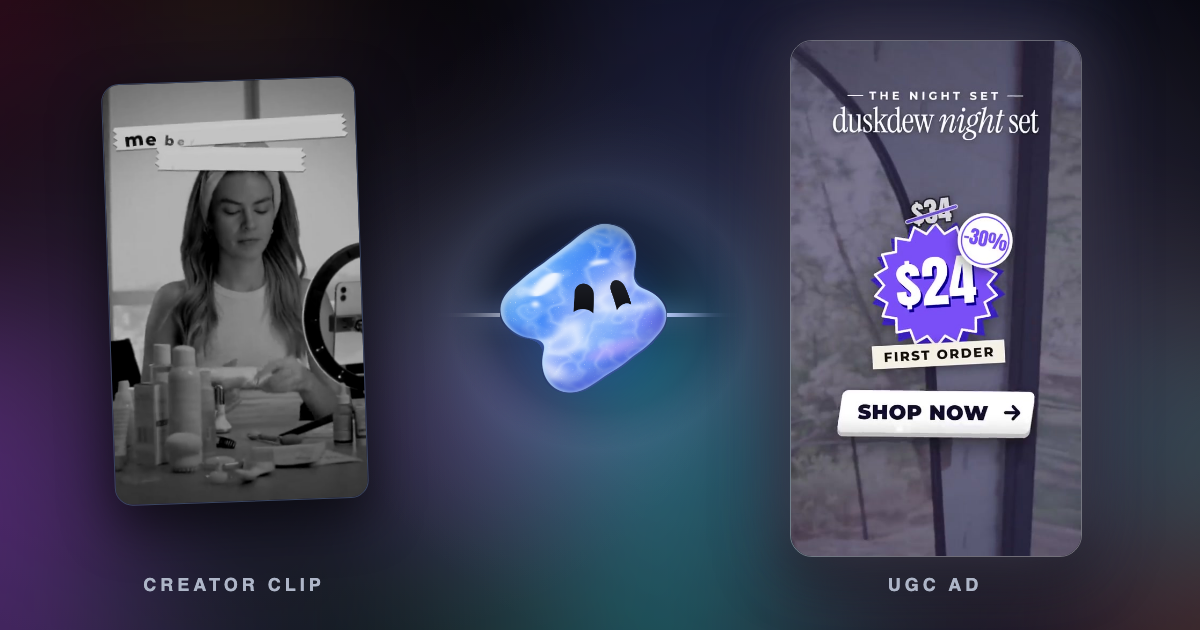
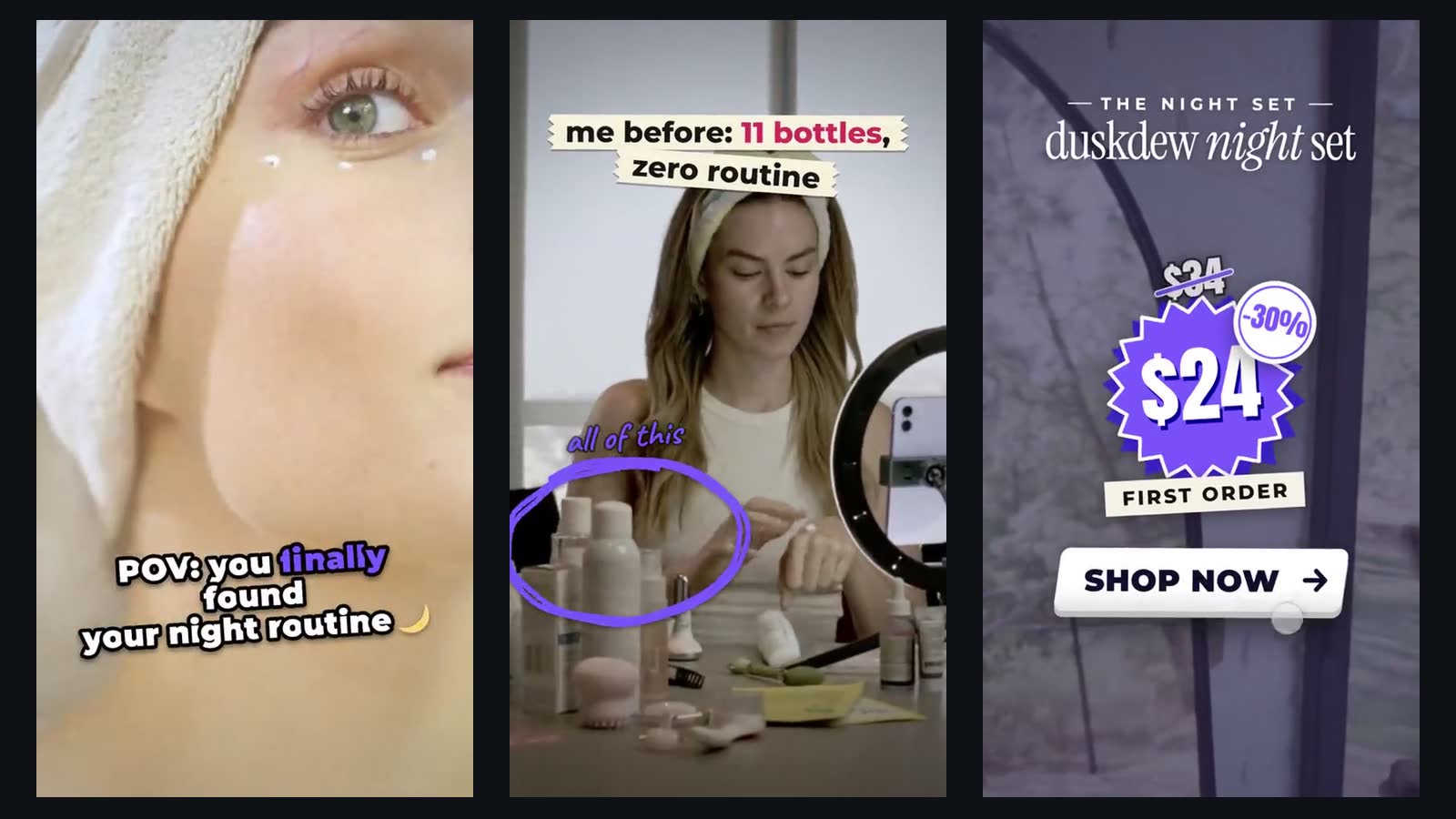
Vidova's ugc-product-ad template builds this shape: a POV hook, the problem, the routine as numbered steps, the price and a Shop now button, in 9:16 at about 17 seconds, with cuts on the beat of a light pop track. The agent searches the templates, fills this one with your clips and adapts it to your brief.
Make a 20-second vertical UGC ad for our night skincare set from Mia's clips. Open on the close-up of the cream with her line "I finally found a night routine I stick to". Show the three steps as numbered captions. Then the price: $24 for the first order. End on Shop now. Keep her real voice. Show "Ad" at the top for the whole video, and keep her line from clip 5: "duskdew sent me this set".
For a second language, add: "Make a Spanish version. Clone Mia's voice from clip 2 and lip-sync her to the Spanish lines. She approved the Spanish version in writing." These are example briefs with an invented creator and brand.
The agent uses only the claims and prices you write. It previews the frames and runs a quality check before it reports back, and each version stays in the project so you can test two hooks.
What the UGC template looks like
Mistakes to avoid
- A generated person presented as a customer.
- Lines the creator would not say, or claims you cannot back up.
- A disclosure only in the post text, not in the video.
- Opening on a logo instead of the product in use.
- A look so polished that it reads as a commercial.
- Text over the product or the face, or under the app buttons. Check the safe zones.
Sources
- FTC: FTC's Endorsement Guides, what people are asking
- FTC: Final rule banning fake reviews and testimonials (August 2024)
- TikTok Community Guidelines: Integrity and authenticity
- TikTok newsroom: AI transparency and Content Credentials (May 2024)
- Meta: Our approach to labeling AI-generated content
- YouTube Help: Disclosing use of GenAI content
Make your first UGC ad
You can start free. Paid plans start at $19 a month, remove the watermark and export up to 4K at 60 fps.